Showing posts with label memories. Show all posts

Monday, 4 March 2019

March mindfulness. Mind full.

Home is where the heart is.

I’ve been pondering much on home, and all what that means, recently. I say recently: it feels as if I have been mulling over ‘home’ in my heart for huge parts of my life, inbetween just getting on with living in whatever home I am in at the time.

Home. Where the heart is. But what do you do when you have left your heart, or little bits of it at least, in various places and you can’t (easily, for anything is possible) go back to visit them? You can’t become reacquainted with those pieces of your heart you left behind, fitting them back into the You who you have become since then. You can only try to recognise in yourself those other parts of the world, the other parts of your life.

And what do you do when someone leaves you, taking tiny – or not so tiny – parts of your heart with them? You can’t say, ‘Oh, give me back that little sliver, that huge chunk, I can’t live without it,’ because it’s not possible. Once gone, it’s gone. Gone for the good of you, keeping you in relationship with the person who dared to leave you. And I’m talking children here, people, children who grew up too quickly and dashed off to have all manner of adventures. On their own. Without you. Just as it should be.

You carry on living, that’s what you do. You don’t die of a partial heart, but you don’t live whole-heartedly either. Part of your heart simply isn’t there. So it doesn’t matter how exciting your life might be right now, or how many adventures of your own you are having, or how settled and happy you are in your Nice Little Life, all safe and cosy: no, deep down you know you only live partially.
And that’s what we do. We live, knowing that we would like to be in two places at once. More, if we are honest with ourselves. Our hearts are at rest where we are and yet longing for Other: Other Places, Other People. We live with dichotomy, with paradox.

But look at it another way. Look at how rich your life is, how widespread your heart across countries, across continents, on the other side of town. You are filled with more experiences than you can count, simply by having been somewhere else. Your heart grows: with love for places, for people, through amazing experiences, encounters with others: new relationships.

Truly, it is a gift. To be able to share one’s life, give one’s heart away to others. A gift.


Wednesday, 25 April 2018

Ann


Ann, two years ago.
The news that my dearest friend, Ann, had passed on was a shock which numbed me until the hour of her funeral. For I could not – cannot - imagine a world without her. She had been part of my life, whether near or far away, for nearly 37 years.

There were many years, of course, when we had little contact because I was in Kenya. We had long-standing jokes: that she didn’t invite me to her wedding : I found out when I rang her, hoping to meet up when I was visiting England, only to hear from her mother that Ann was on her honeymoon. I hadn’t even realised that she was engaged. I forgave when I realised how happy she was with Richard. He became a dear friend: we loved them both dearly.

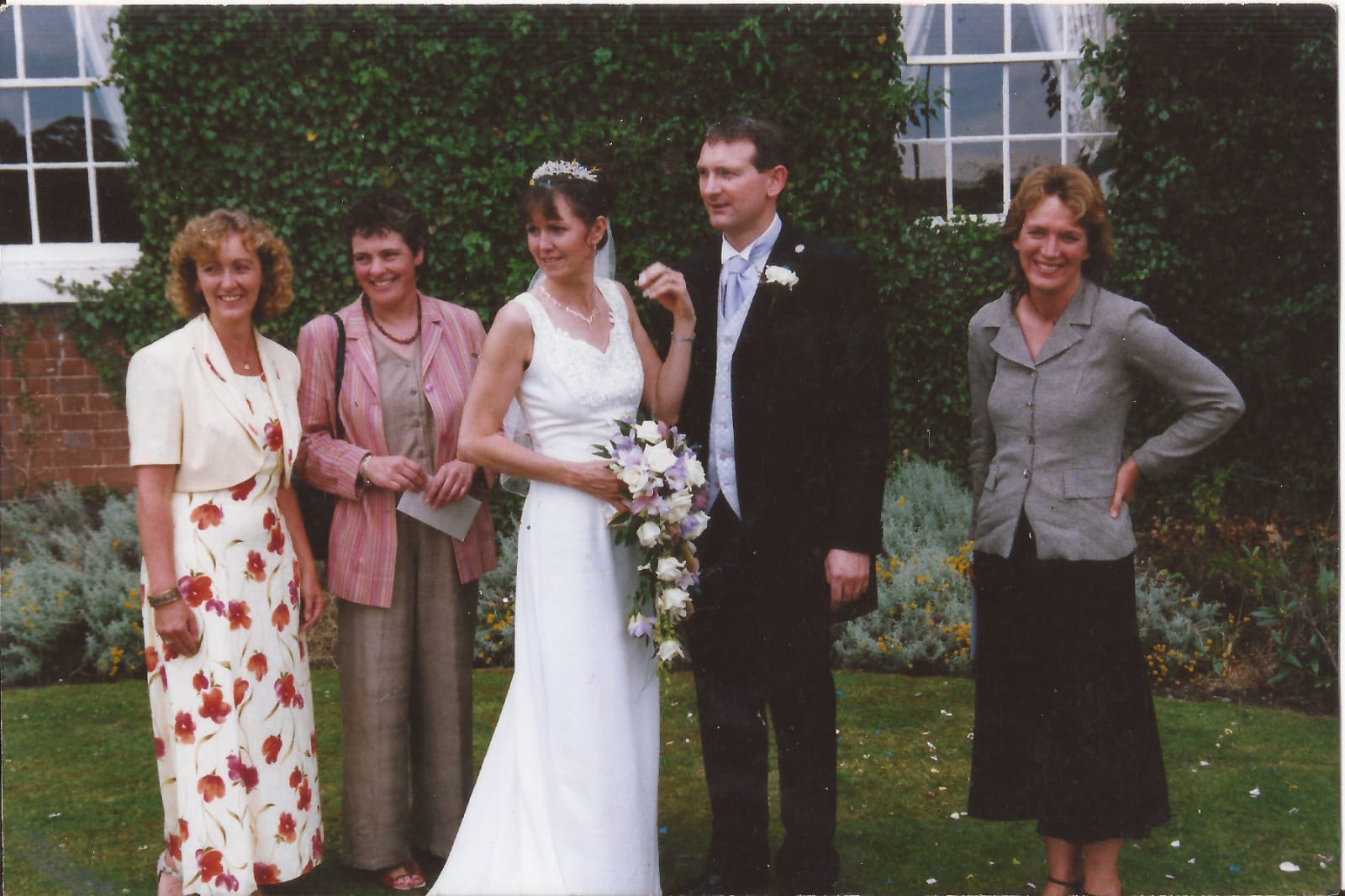
Ann insisted – until I found a photo to prove the contrary – that she had never come to my own wedding, claiming that she hadn’t been invited. So, we joked, poring over the wedding album: there you are, Ann; you must have gatecrashed AND got yourself into the official wedding photos.

Such a quick wit: the time she told me she’d had to take the day easy as she knew she had a stressful hospital visit in the afternoon and that she would be seeing me afterwards, which would be ‘traumatic’ – her word.  I shudder to think about my riposte on hearing that she had planned her funeral: I asked her, in jest of course, when it would be. “I’ll let you know,” she replied. But of course she didn’t. It was up to her husband Richard to do that.
Ann and Richard, October 2016.

Ann, October 2016
I didn’t want her to die. I DIDN’T WANT HER TO DIE.  What would the world look like without her?

Ann, who was closer than a sister. Who knew me inside and out, told me truth about myself as no one in the entire world could. Spoke truth into my life and my heart. She touched me in the deepest part of my soul. She could put her finger on things in me which I barely knew myself. Sometimes, indeed, the truth she spoke to me about myself hurt (Truth has its way of doing that): but I knew I was unconditionally loved. She was a rock of encouragement, love and truth. To lose her is indeed to lose a sister, a friend who was and is, as the Bible says: “Closer than a brother.” (That verse applies to sisters, too!)

We have shared endless hours of talking, late into the night. Shared a bed, sleeping top to tail in the simplest of ‘hotellis’ en route to visit Lake Turkana. Shared hopes and dreams, but more often fears and failures and difficulties and yet ending up laughing and encouraged.

We could stay up all night. We shared our most embarrassing and foolish moments – and liked to remind each other of them, as well. We made each other laugh.  I didn’t see enough of her, although periodic phone calls were always revitalizing. And looonng. 

July 1981 was the first time I met her, in London Colney in Hertfordshire at the headquarters of the Volunteer Missionary Movement. We’d both joined as volunteer teachers, hoping to be used by God in Africa, responding to words from Isaiah: “Here I am, send me.”  We’d sat next to each other during the first community prayer and worship session, watching in bemusement as, gradually, the others rose to their feet and joined in dancing around the chapel to the refrain of ‘Bind us together’. She turned to me after it was finished and nearly everyone had left. “I don’t think this is for me,” she said. “Me neither,” was my reply. We instantly bonded, survived the preparation course, went out to Kenya where we worked about an hour’s drive away from each other and even travelled on the same plane. We did indeed learn to clap and sing in praise and worship - it WAS our ‘thing’, after all. A few months later on 2nd February 1982, we both set foot on Kenyan soil for the first time, living and working an hour away from each other.

We visited quite frequently, each struggling with our own challenges: adjusting to the simplicity of life in rural Kenya was the least of them. Addressing our own inner demons and shortcomings, coming to terms with the real inner person, was sometimes more than we could manage but we learned to face them and support each other.  We journeyed up to Lake Turkana together in buses and matatus and on the back of a maize lorry.  Ann’s compassion for the poor, her knowledge of geography and her large and close-knit family left me a little in awe of her: but she was always able to dispel any false notions I had with a quick comment.

Even the Africans thought we were sisters, though her hair was straighter and longer than mine: there was still a similarity in our heights, figures and the way we walked.

Her unwavering faith has been an inspiration. I have been privileged to pray for her, alone and in silence, with her and out loud. In a garden centre parking lot and in a chapel of healing.

And kind. Ann was so kind. She loved my parents, who were ‘very good’ to her – I took their friendliness and hospitality for granted, but she never did, valuing them tremendously. She would meet my plane when I came to visit my parents in Cheshire, driving miles to Manchester Airport to pick me up. One time, she was half an hour late: she’d got lost in the airport, driving round and round until she finally found me. She stopped the car on a double yellow line, turned off the engine and threw her arms around me in a tremendous hug. I noticed a police car just a few yards away. “Um, Ann – there’s a police car just there. Do you think we should move off – we’re illegally parked.” She dismissed my suggestion with a wave of her hands. “Oh, it’s fine – we’re old friends. I’ve had to ask them several times how to find where to pick you up.”

She was wonderful at recognising beauty in other people and in circumstances. She was quick to recognise God’s loving hand in prompting others to action. She loved flowers, birds, nature...

I loved her absolute dedication to our Lord Jesus. Like all of us, she had questions and doubts but once determined, she was resolute in what she did. I admired her patience and commitment. And she was so REAL, with such a brilliant sense of humour.

And how we laughed and laughed together, especially over the memory of our embarrassment when we tried to photobomb Cath’s wedding photo. Well, we didn’t really, we just wanted a snap of her with all of us – including Mary D (Mary Doherty, who became Mary Carpenter and then moved to Westport in Ireland) – but it wasn’t a suitable time and so we were asked to move!!  We never let Cath forget that...that she ‘didn’t want’ us in her wedding photo.


The talking, talking, talking: for hours.  The blessing of being known and loved unconditionally. The encouragement, the reminders of God’s goodness. So much love.

Visits were treasured. Ann visited me in Guernsey several times: once, just after her mother died, on Mothering Sunday, taking a Mother's Day gift of a pot of primulas from our church service back home with her. She came, twice, with our other two 'sisters', Cath and Mary. We had such fun: we walked and explored; at breakfast in the garden; gathered on the sofa bed late at night, talking and drinking Bailey's with ice - Mary's idea; went kayaking, which produced one of the funniest memories. 

Our first 'sisters' visit to Guernsey in 2009.


Ann clowning around near the bottom of the cliffs. Yet it was on the path just above this, as we climbed back up, that she became so breathless, having to stop, coughing. We urged her to get her breathlessness checked up on.... it was the beginning of the cancer, diagnosed a few months later....


Meeting up with Alan Jouanny and family on Herm. Alan, from Jersey, had been with us in Kenya, also in the same group with VMM, travelling out with us on the same plane....

Ann had more than a little trouble getting used to her bike...

Such fun... so many happy memories...


We had a double kayak, so Mary and I set out across the bay while Cath and Ann changed into wetsuits. I wish I'd been there. Ann had tremendous difficulty with her wetsuit. It's not easy to pull on tight neoprene in any case - almost a learned skill, but Ann managed to get hers on a total of three times. The first time: back to front. Oops, uncomfortable. The second time: inside out. Hmmm. The third time, she nearly got it upside down but managed to work it out and get it on properly. I can't remember how she extricated herself afterwards...


But during the summer visit in 2009, she alarmed us by having to stop during a walk on the cliffs to catch her breath, pausing for a while. "It's just asthma," she panted, "at least, the doctor thinks so."

"Ann, you need to get it checked out properly," I urged, concerned: it didn't sound like asthma to me.
It wasn't. A couple of months later, and lung cancer - the same cancer which her mother had suffered from - was diagnosed.
The top of the cliffs... where we first noticed something was wrong.
We googled it. Prognosis: no more than five years. Ann defied the odds, again and again, but there was no cure and she was not healed in her physical body here.

There were other times we all met up, including a visit to Ireland and a return visit to Guernsey. 


But there was also a time when Ann could not make one of our get togethers in Lichfield: she had been away for several days on a long-distance walk and had something else a couple of days later. She was tired and couldn't fit it in. But we knew, also, that she had begun to prepare herself for her departure, with pilgrimage and prayer and an increased focus, especially after early retirement, on good works. She was involved with various social and healing ministries, being a trustee of one charity and attending healing weekends, praying with people. Her compassion always extended outwards, away from herself.

A year before she died, as Ann was, even then, dying, she was at a particular crisis point.  She had developed lung cancer when she was 52 and hung on until she was nearly 61, another 8 years or so. A blockage had caused her intense breathing difficulties; there was then a ‘procedure’ to remove it; and then, as she was unable to breathe without a machine, she was put into an induced ‘sleep’. A coma. Then the doctors told us to ‘prepare for the worst’.

For her, of course, it was not the worst. She had longed to be united with her Lord and Saviour, whose Spirit she adored and had pursued with prayer and good works for many years. Indeed, these last few years especially seemed to have been a time of preparation. She was involved in pilgrimages and healing ministries, supporting the work of others with her prayer and involvement.

But for me, it was – and is - the worst. I did not want to lose her.

I prayed for a miracle. I prayed that the Spirit touched her poor body so powerfully that all traces of cancer and disease would be removed. I prayed for COMPLETE and MIRACULOUS HEALING.

I was not ready to let her go. She was far too precious. Angry at the thought of losing her – for I could not imagine her not being in my life here on earth – I cried out to God. This could not be her time.

And it wasn’t. As I prayed, I envisaged her lying peacefully in her white hospital room: white sheets, white walls, windows set high up above eye level. And on the window ledges were perched white angels: the beautiful feathery pre-Raphelite type of angel, watching over her.

It seemed like an eternity: a week, ten days...? News from Ann’s husband Richard was that she was ‘sleeping’ peacefully. It sounded as if she was drifting away, but still we prayed... until, one Sunday morning, I ‘saw’ the angels again, this time in beautiful rainbow hues, gently multi-coloured and bright. Then the news came: Ann had woken up, was sitting up, even, with tea and toast. By Tuesday she was home.

A reprieve.

But it was not to be. She struggled bravely on, enduring procedure after procedure. A year after her ‘return’, she went back to hospital for another procedure. Already very weak and weary, she developed pneumonia, slipping gently away a few days later.

And again, unknowing, I had a sense that she had passed through the door. We had been in France, travelling around, visiting many old churches. Several of them were on the Compostelle route, the pilgrimage to Santiago, the Way of St James. I thought often of Ann: we talked about pilgrimage, a dream she had of walking the Way. She never managed it, though she did other walks and spent her life as an eager pilgrim, constantly seeking out God and extending his compassion to others.

The day she died, we visited a village which was a centre for pilgrims: two routes converged before continuing south towards Spain. As I walked into a huge ancient church, so dark inside that it was difficult to distinguish the paintings over the altar, I noticed a large display of votive candles. Many were lit and glowing alive, testimony to the prayers people had said as they lit the candle for a loved one or a particular cause.

The thought entered my mind to light a candle for her. I had seen these votive candles many times, but never felt prompted to light one until then. I told myself I might do it on my way out, choosing to wander round the church first. As I neared the display again, still half-wondering about lighting one, I remembered that it is a Catholic tradition to pray for the dead as well as those alive who might need some form of healing. I felt a check. It felt ‘wrong’ to light a candle for Ann when she was alive. Lighting a candle did not validate my prayers for her healing: I knew God loved her even more than I did and had her safely in his arms, regardless of what I did or didn’t do.
I remembered Jesus’s words to the women who had gone to the tomb on the morning of his resurrection: “Why do you look for the living among the dead?” Lighting a candle seemed, in that moment, to be lighting a candle for the dead. And I wanted, so urgently, for Ann to live.

I left the church, candle unlit. Returning to the motorhome, I picked up a message: Ann had passed on that same morning: perhaps half an hour before I was in the church. She WAS dead. But NO!  Ann has the gift of eternal life! She is ALIVE and safe in heaven with the Lord she loved so dearly.
Candles in Pons, just before.
Lighting candles had absolutely nothing to do with it. God could have healed her miraculously, yet he chose to take her home to be with him. We had had the gift of years with her: something, indeed, to be tremendously thankful for.

And yet. The news numbed me: I barely spoke for days.

Since hearing the news about Ann, I felt as if I had  died. Completely empty. I couldn’t speak, couldn’t cry, couldn’t feel anything. Numb.

I regret I didn’t see more of her, especially these latter years. I regret I didn’t write more, phone more, especially in the last couple of years of her illness. But how do you face a friend’s losing battle with mortality? How do you face, together, a future where one will be in heaven and the other still struggling here on earth. I don’t know.

Life went on in all its aspects. Ann’s passing seemed unreal, as if I could message or phone her on my return home,  just as before. It became reality when I heard when the funeral was, making arrangements to take the day off work to attend. When I had to tell people, just a little, about Ann and what she meant to me. The days crawled.

It hung heavy on me, the funeral. The day before went about its business with mundane joys, functioning as normal. So did I. Yet, in the pit of my stomach, lurking over my shoulder, hanging heavy on my heart was the knowledge of loss.

I suppose I knew it was coming. Few survive lung cancer for more than five years: Ann outlasted all the doctors’ predictions, living for over eight. Yet nothing prepared me for this huge sense of loss. As soon as I saw her photo in the church, I started weeping, continuing without break for the entire service. In the following hours and days, I found myself frequently breaking into tears.

Metaphors and analogies help.

I am a seedling, pulled away from my siblings whose roots are intricately entangled with mine. Part of me has been ripped off, left behind as I am forced into a new and different life without her.

I am shattered into pieces: they will come together again, form ‘me’ again, but I will not be the same. The jigsaw will be imperfect, misshapen like a strange Picasso imitation. I will not be ‘right’ without her.

There is a hole in me, a gouged-out bite savaging my flesh, leaving a gaping, tattered wound. It will heal, but torn tissue remains, weeping silently. My life’s blood has seeped out in tears, in the legacy of malignant cells, in hospital imaginings from afar.

I carry a heavy stone of grief and loss and sorrow.

And yet.... Jesus is calling. Calling to the transplant, the lonely orphan forced into a different life, a without-Ann life, calling me to come home to him.

Jesus is holding me, piecing me together, gently carrying me in all my brokenness.
Jesus is filling up the wounds, flesh on and in flesh, pouring himself into me.
Jesus carries my grief with me, bearing so much of it that it begins to lighten and lessen....
Jesus is here.

And just today, I read this similar reflection on Jesus in the middle of the mess, the broken, the unperfect life we live....We all deal with the same things...

Ann - the last time I saw her, six months before she died. Her spirit as indomitable as ever, her sense of humour always to the fore, weary as she was.


Saturday, 6 September 2014

30 years...a brief (very brief) summary

Yesterday was our thirtieth wedding anniversary. (I think. I get muddled up with these ordinal numbers, but I think that is right. In any case, we have been married for thirty years.)

THIRTY years!  How did that happen?!

Thirty years of adventure. Not in a very great sense, in some ways, but perhaps we have seen more adventure and change than many of our peers who have spent all their lives in the UK.

In the last thirty years married to Richard, I have:
  1. Given birth to twins. A boy and a girl. Now grown up. Wonderful people.
  2. Moved house several times. ( See footnote )
  3. Laughed. A lot. Cried some. Shared my heart.
  4. Moved continent and culture. Only one major adjustment; several minor ones. 
  5. Travelled backwards and forwards between Africa and Europe, and across the globe.
  6. Lived in a tent. Twice. For several weeks at a time.
  7. Learned to study the Bible, joined Bible study groups and led Bible studies.
  8. Lived in a tin hut. Nine months, that one.
  9. Cooked over open fires, on antique wood-burning stoves and on a very elderly, running-off-a- gas-cylinder cooker.
  10. Lived in a wooden house - built from cedar from Mount Kenya.
  11. Made good friends from many different countries, most of whom are now, also, scattered across the globe.
  12. Lived in a bungalow, a large Victorian terrace, a modern house and several converted barns...
  13. Run a gliding club. Challenging.
  14. Run a golf club. Even more challenging.
  15. Flown, often, in aeroplanes, from huge jets to tiny two-seaters.
  16. Camped in remote parts of the African bush - and even, not so remotely, in Europe, too.
  17. Been chased by elephants.
  18. Listened to leopards and hyenas.
  19. Tracked animal footprints. Yes, even lions.
  20. Encountered snakes. Too many times.
  21. Bathed in hot water springs.
  22. Learned to drive on murram roads, in mud, and past corrupt policemen.
  23. Been robbed at home, at knife point.
  24. Written stories and, occasionally, published articles.
  25. Sailed, canoed and travelled by boat and barge on lakes, rivers and canals. 
  26. Swum in the warm Indian ocean and the cold Atlantic.
  27. Enjoyed crafting and making cards.
  28. Taught many children.
  29. Become adept at using computer technology.
  30. Written a blog!
Each one tells a story of its own.  And in the previous thirty years? That's another story altogether...

So, we celebrated. With friends. Afternoon tea, tapas lunch. Cake for my colleagues, chocolate for my pupils. And a special meal out...

Overwhelmed with blessing, kind thoughts, touching cards, gifts and beautiful flowers. #feelingloved

2.A list of some of the places we have lived in:


                                                                              Lanet.


                                                                 Njoro Country Club.


                                                                 Mweiga Airfield


                                                           Aberdare Country Club.


Kiganjo


Nairobi


Rugby.


Bailloterie.


4 Cabot.


Barnsfield.

Thursday, 21 August 2014

Camping. Glamping?

I have been camping - both on holiday and, occasionally, as a lifestyle: but that's another story - most of my life. I started when I was eleven, when my parents decided that hotel holidays with four children were becoming too expensive, so they bought the largest frame tent they could find and the rest was history.

We are still using some of the equipment from those epic trips around Europe: the 40 year old plastic water carrier (French); the hanging wardrobes, superb for storing all kinds of items, although then we used them for clothes; the stacking saucepans, all fitting in neatly one inside the other; we even have one of the canvas campbeds and a couple of thick sleeping bags which zip together neatly.

My father developed the art of packing the car to an extreme. In days before seatbelts, he took out the back seat and replaced it with tightly bundled sleeping bags tied down with string onto bamboo struts. Add an overstuffed boot, stuff in the rear footwell and a crammed-to-capacity roofrack and we were good to go.

And, of course, we drove for hours and hours and hours. Which is partly why I am more than a little envious of these good friends who camp in France with their tandem. Tent, sleeping bags, cooking equipment and clothes all fit neatly into the panniers or the little trailer. There is room for a good-sized umbrella strapped to the main frame, while laundry is efficiently air-dried from its position draped over the handlebars.


The lure of cycle camping is still there, but I can't complain. Since those childhood trips, camping for me has mostly consisted of a heavy canvas safari tent, complete with wooden poles, in the middle of the bush. When we were first married, we could decide to go camping and be off on safari within half an hour. We had a camping box stocked with enamel cups and plates, simple cutlery, matches and washing up liquid, a gas lamp and stove for emergencies.

Our favourite site was in a remote part of a Lake Bogoria game reserve, populated by flamingoes, greater kudu and the resident leopard, all of which we have seen strolling a few yards from our tent. Throw in scorpions and snakes for excitement and some to spare. A freshwater spring trickled down from the hillside above us and fig trees provided gentle shade. It was a truly magical place.

We took our children camping when they were only a few months old. On our first trip, our daughter screamed while we drove on tarmac, only calming when we bumped and lurched along a murram road, hugely potholed and rutted after heavy rains had wrought their havoc. She has been enthusiastic about trail and bush expeditions ever since.

Our tent rarely saw another in all those years. Remote and isolated, save for wildlife, was our dream. Hyenas  and lions kept us awake at night, occasionally nosing round the outside of our tent and, once, removing laundry from a hanging branch nearby. Superb starlings flocked within touching distance. Elephants walked curiously through the campsite as we watched cautiously from a safe - or so we hoped - distance. And striking camp was ALWAYS exciting - we never knew what we might find hiding beneath the groundsheet.

Then we moved to England, exchanging our faithful wooden camping box for plastic crates, our canvas tent for a lightweight dome. Shocked by the unwelcoming climate, we camped only in Portugal (by air: tent and box came with us, the ground was our seating and our bed tiny self-inflating mattresses). Until New Wine.

Camping within touching distance of the next tent was a new experience - not to mention being with over 10,000 others on the Bath and West Showground at Shepton Mallet. We discovered a new kind of camping, living in community with others from the church for a week. The weather had to be accepted as it was and, generally, was reasonably kind although we were also 'treated' to torrential rain and thunderstorms at times. This was July in England, after all.

Now, our camping has ventured into new territories.  Here at Le Pas Opton, France, we have an idyllic spot by a river, enclosed by hedges. Not only do we have running water, flush toilets and hot showers but, for the first time, we camp With Electricity. Overhead and table lights; a kettle; and a slow cooker.  Beach chairs and an inflatable sofa; rugs on the floor; a tablecloth on the coffee table. No sleeping bags and mattresses, but an airbed complete with sheets, pillows and cosy duvet. No lengthy cooking chores: instead, we prepare a meal in the morning and it is ready for us when we return after an afternoon out. Add to that, a huge tent with living room space and picture windows.

As I wander up to the loos (yes, a walk to the toilets is still a feature of everyday life) in my satin pyjamas (elegant daughter's cast-offs), I wonder: is this, perhaps, glamping?
Evening ambience

Glamping

Sunday, 14 October 2012

Ursula Wolff, my mother


Just back from my mother’s funeral – she died on October 3rd – so am just recording some family memories put together for the occasion. Not my blogpost, really. 

Memories of Ursula Wolff

Her son Matthew 
Mum had very strong memories of her childhood in India and shared them with us often.  She often mentioned her first seven years in Lahore. Having a race with her father in the garden and being shocked that he didn't let her win! She remembers travelling by train, winding up through the hills to Simla or Srinagar where she would spend the summer with her mother and sister to escape the heat of Lahore.  Mum had exotic stories of travelling back on the ships from India to England via the Suez canal and stopping off in such places as Malta.  She had vivid memories of playing with a little friend on the upper deck and splashing around with hoses while the sailors, who played along, were trying to wash down the decks.

Mum spoke often of her wonderful aunts who looked after her while she was in England and her own parents were in India. She visited her Aunty Madeleine and Uncle Eulich (one of her father's sisters and her husband) in Muswell Hill every Sunday and became close to her cousins. She spent her holidays with her Auntie Trixie and Uncle Fred (her mother's sister and husband). After the war, she went to live with Auntie Cissie and Auntie Charlotte (two more of her father's sisters) in Lutterworth. It was in Lutterworth that she met our father.

The second world war of course had a big impact on our mother. An incredibly generous person, the war also taught my mother not to be wasteful, lessons which people are only now beginning to re-learn.

I'll remember Mum for so many wonderful things but especially her love and warmth.  She had lots of interests and enthusiasms including beautiful gardens, books, travelling to new places, spending time with people from other countries, looking after animals. She passed many, or even all, of these passions to her children, and to her grand-children to whom she was devoted.  

She had a great sense of humour, an infectious laugh and sparkly eyes.

I have fond memories of Mummy and Paula giggling together conspiratorially.

My friends remember Mum for her generosity and for treating them as if they were her own family. Her simnel cake is famous amongst them. Some have the recipe and have lovely memories of savouring her beautifully decorated and delicious simnel cakes. 

Her daughter Isabel 
a.  Her famously lavish hospitality when family and friends visited – the table groaning under the weight of her chocolate cakes, sandwiches, home made biscuits and brandy snaps, flans and her ‘incomparable’ chocolate mousse (Frances Mary mentioned this to me.)   She loved cooking – especially anything sweet.
b.  Her love of the Scilly Isles – a place that she and Paul discovered together, and that they were to visit again and again with their children and, later, grandchildren.
c.  Her infectious laugh.
c.  She adored having foreign exchange students in the house, from France, Germany, Austria, and Switzerland, and devoted herself to helping them learn English, making them practice their vocabulary and pronunciation again and again, and with Paul, she was energetic in showing these children as much of the UK as could be fitted into their stay – the Cotswolds, the Lake District, Lyme Regis, Devon and the Scillies. They all have warm memories of the generous interest she took in them.
d.  Her love of gardening – she was extremely well informed about the botanical names of plants, and she and Paul filled their walled garden at Rugby, and later at Canalside in Northwich with a blaze of ceanothus, cotoneasta, clematis, roses, phlox, lilies of the valley and many others.
e.  Her love of animals – she happily made room for dogs, cats, gerbils, stick insects, and, with slightly more reluctance, Rupert the Rat who Angela saved from vivisection.  It was a ‘pity’ she said, that it had a ‘rather revolting tail’.
f. One defining characteristic was a kind of (slightly innocent), girlish charm. 
g. Mummy had a lovely smile and was a very appreciative person.

Personal Qualities

a.  Mummy showed a lot of courage.  Born in Lahore, the eldest of 3 children, she was sent home to St Martin’s convent in Muswell Hill and there were long years when she didn’t see her parents, who were still in India, and unable to get a passage home because of the war.  Mummy went there at 7, in 1931, and only saw her parents again in 1936, then not until 1943 when her mother - we called her 'Nonna' - came back on her own. She saw her father again in 1946 so she hadn’t seen him for 10 years. She bore this with fortitude, never complaining in later life about it, simply saying that it was just ‘the way it was in those days.’  But her sadness at not having a family life with her mother, father and two younger siblings can be imagined.  However she spent happy holidays with her Auntie Madeleine, Uncle Fred and her cousins in Ealing, and later, when she left school, with two maiden Aunts in Lutterworth.  It was here, aged 17, that she went to work locally as a secretary at Power Jets, where Frank Whittle and his team had developed the jet engine, and were testing new fighter jets for the war.  One of the team of young engineers was Paul Wolff, just down from Cambridge, who had noticed Ursula’s blue eyes, her very pretty face, and her laughter.  So he plucked up the courage into her office and ask her if he could have a pencil from the stationary cupboard, which was her domain.  As this went very well, he then he asked her if she’d like to go to a concert with him at the de Montfort Hall in Leicester, and that, pretty much, was that.  They married in 1953, and moved to Rugby where they bought 75 Clifton Road, a house in which they brought up their four children, and which they were to own for fifty years.  At their fiftieth wedding anniversary in 2003, Paul said in his speech ‘Ursula was my first love, and is my only love.’  She had the blessings of a strong and happy marriage, and of having had four children.  She had to bear the great sadness of losing Simon, in 1995, and again showed courage and fortitude in this.  In their retired years she and Paul spent many happy times together going on holidays or trips to National Trust properties or gardening together or, best of all, spending time with their children and grandchildren.

b.  Very affectionate mother, endlessly interested in what her children, and grandchildren, were all doing – never happier than when we were with them.  Very welcoming to all her children’s friends.   She was a devoted daughter to her mother, Irene, and a wonderful daughter-in-law to Paul’s mother, Lucy, both of whom spent nearly every weekend at (my parents’ home in) Rugby.

Her daughters-in-law
- She had an eye for a good bargain and loved to share the results with everyone in the family. Useful household items (cake tins, handy-sized colanders, letter scales, purses) were distributed at regular intervals.
- Although she was home-loving and very family-centred, she definitely also had itchy feet! She loved going for drives in the countryside and calling in for a pub lunch somewhere (though she stuck religiously to lemonade)
- She adored sitting in the sun - anytime, anywhere - and was quite happy to wait outside on a bench in the sun whilst the rest of us wandered off and did other things. A picture of contentment.
- She loved the seaside and thought beachcombing great fun, especially looking for pretty shells
- She had a stock of family tales of past adventures and places visited. She'd start the tale off and get Paul to fill in the geographical and chronological details. A family ritual.
- She had firm favourites both in literature and film. Every Christmas (and many other times too) we would watch videos of Mr Bean and Those Magnificent Men in their Flying Machines. Cue shrieks of laughter from both grandma and grandchildren.
- Ursula loved playing with all her grandchildren.
Ursula tended to stock up on things. We have only just run out of cling-film from the cottage!  (5 years after it was cleared.) 
She was very good at throwing and catching and never dropped a tennis ball!

The grandchildren 
- She loved doing "Round and round the garden, like a teddy bear" when we were young
- She liked teaching us the names of flowers (on the Scillies)
- She had a great laugh
- She loved going out for pub lunches

My friends Lena and Ulf, who live in Sweden, wrote:  “We are very glad to have had the opportunities to meet Mrs. Wolff a couple of times. We liked her "British lady" style and her wits, humour and bright mind.Ulf remembers especially taking your parents on an outing to Öland, and when asking them how they found Öland, Mrs. Wolff answered with british "not-get-impressed" tone of voice: Well, I think it just looked like Siberia... Ulf just loved that comment. We also have very good memories of Mrs. Wolff from the years we met in Rugby. We also cherish Mrs. Wolff´s concern for us sending us a piece of your wedding cake as we were unable to attend the ceremony. We still keep that particular parcel in our fridge and it has even accompanied us when changing houses.”

I had nothing left to improve on this, save that she had a good sense of humour, loved jokes, and loved shopping – especially for bargains!

October 10th 2012

Tuesday, 18 August 2009

'Sisters'

24 hours ago they were here. Leaving them at the airport felt very strange. Wrong, somehow.

Leaving my ‘sisters’.

These dear friends – a friendship which goes back nearly thirty years – came to visit. Our days were filled with laughter, reminisces, secrets told, more laughter…

Days of wonder, as we looked at the Little Chapel, so lovingly crafted out of shells and fragments of porcelain and pottery.

Days of exhaustion, walking the steepness of the cliffs. Marvelling at the birds soaring above us, the tiny flowers clinging to the spare soil beneath our feet.

Days of laughter, when we couldn’t stop smiling for the joy of being together – especially when we met up with Alan, also a friend from Kenya days. I’d kept it a surprise for them. Their shrieks of amazement and delight, when they met him on Herm as we stepped off the boat from Guernsey, brought smiles to the faces of strangers.

Days of enjoying the sun, the sand, the shells and the sea air.

Days of eating and drinking in celebration of a birthday, a reunion, thanksgiving for the years then and now.

Days of the comfort of being known so intimately that there seemed to be nothing we couldn’t talk about and share with each other. Days when we realized that there are very few others who we love so much that we feel as close as family.

We plan to meet up again soon. Because leaving felt so very, very strange.

Leaving my ‘sisters’.

Sunday, 11 January 2009

Christmas Memories


I have just begun to take the Christmas decorations down. I never hurry this process and this year was no exception. We were busy enough before Jonny and Cat returned to uni and I didn't want to waste precious time with this rather depressing chore. Of course, it's always lovely to clean and tidy after the holidays but the rooms always look somewhat bare initially.


This year was different.
As I was carefully stripping the tree of its ornaments, laying each down in its allotted pile, I realised that every little trinket had a precious memory attached to it.
At the top of the tree hung an angel. Bald head of crumpled silver foil, skirt made from a doily which had once been pink, but is now faded, and silver foil wings folded concertina-fashion. The wings are torn in places, but every year we tweak them back into shape. She is 15 years old, made by Catharine when she was in my friend Shirley's class. Shirley is now a deliriously happy grandma, living in New Zealand.

Just below the angel is a wonderfully beaded star, made by Maasai ladies who live in a remote part of Kenya, working for a bead project which has been started by missionary friends of ours. We have known Peter and Tammy since their oldest boy was one year old. He goes to college this year, leaving their home in Tanzania to travel to the US.

More bead angels hang over the fireplace, hovering over the African nativity set. Made from several different colours of clay, the expressions on the faces are wonderful. Mary, kneeling in front of the crib, looks mildly surprised; Joseph next to her as if he is just regaining consciousness. The shepherd is posing awkwardly for a photoshoot he never wanted to take part in anyway, while the cow and donkey look surprisingly smug. As for the kings… polite interest best describes them, as if they know they are in the right place but can't quite believe it.
Below, along the length of the mantelpiece, hang a chain of claydough stars, hearts and bells, painted gold. We made these when Catharine was 14, along with a set of advent figures, each hand crafted with a relevant Bible verse on the back. We hang these, each day of Advent, on a tree of twigs, starting on 1st December.
Back to the tree. First to come off are half a dozen tiny woven sisal baskets, ciondo from Kenya. Miniature versions of the baskets the women carry their wares to market in, long straps hanging off their foreheads as they balance the heavy basket on their backs. They are all different: one in particular looks very authentic – it is faded and dirty. We left it on the tree by mistake one year, discovering it several months later. Another is artistically woven with beads and seeds, its colourful strap too delicate for real use: a tourist offering. Then there is a minute flat coiled basket, and one, just a couple of inches tall, with a conical cover: it comes from the Sudan. Every year we fill these with sweets – jelly babies, usually. We started to do that on our first Christmas in Guernsey, when Richard was still living here on his own before we all moved over.

Another group of ornaments is reminiscent of my years teaching English in Sweden. Jultomte (Santa Claus' elves) made of grey, black, red and white wool and felt with hand drawn faces, one made by a neighbour, others given by pupils.

There is a Christmas bird, a bullfinch which I made from wool with a group of women I taught banking English to. There are small straw Christmas stars and the 'Syndabocken' , the Biblical goat onto which the sins of the people were put. Red or white crocheted hearts. At Christmas Swedish homes are symphonies of red and white, of wool, straw and wood. Not a piece of tinsel or glitter in sight, just a plethora of candles and natural materials. I smile at the memories.
Next come two small teddy bears, each sporting a red crocheted cap and waistcoat, wearing narrow green neckties. Presents to Jonny and Cat from my mother, proudly dangling from the bottom of the tree. Then there are 5 angels – there were 6. One of them – she must be getting on for twenty years old now - came from Kenya, from the Swedish community's Lucia fair. My friend Gunnel made small tomte out of tiny gourds, dressing them in red hats and scarves; someone else made these exquisite angels from white and silver card paper. The other angels are mere infants: Cat and I made them from card and glitter as placemarkers for our Christmas meal two years ago, each with our name on.
Now I can glimpse the animals lurking in the branches; lion, rhino, hippo, ostrich, giraffe, tortoise, elephant, impala, zebra, warthog… most are made of gilded wood, given to me in a banana fibre box by a parent at the prep school I taught in.

Others are made of china, mended several times after contact with hard wooden floors. These were made by Dee, a white Kenyan friend, each lovingly handpainted with bizarre detail; the giraffe wears a red scarf around its neck, zebra and wildebeest carry striped stockings dangling from their mouths or horns: the lion wears a large red-spotted tie.
After that it is the turn of the seeds, acquired with the children were babies. I painted these with silver paint, normally used as primer for the gliders we owned and flew over the game lodge Treetops and the Aberdare Mountains. Sharp whistling thorn, flat-pursed jacaranda seeds, eucalyptus – the paint has stayed on for twenty years. One of the flowerheads – I don't even know its name – the children found in their godfather's garden. "That would make a good Christmas decoration," said his sister, my dear friend Mary, who I lost to cancer a dozen years ago. And so it did.
Tucked in among them is a little cluster of foil leaves, markings pressed into the surface, which Jonny made when he was 12. And a few silver fir cones from our garden here in Guernsey.

The memories are flooding by me now. My mind flits back and forth over the years, but now I shall describe them chronologically. A tiny version of the New Testament with a gilt metal frame, just an inch tall. My mother put it in my stocking when I was a teenager and it has miraculously survived thirty years and many house moves. The print is so tiny that it cannot be read without a magnifying glass.
A carved painted wooden toucan, from my friend Lisa who I met after I had been married just a couple of months. The silver star, embroidered with gold thread, which Jonny made when he was almost four. I took his skill with his hands for granted: it was a long time before I realized that his artistic ability is exceptional. A Christmas picture made from a discarded card and interwoven toothpicks by my American friend Evelyn Rinella. The fretwork elephant and angel which Joy, the sister of missionary friends, gave us the Christmas she spent with us. A blue and white painted fish from Sri Lankan friends. The miniature framed photographs of Jonny and Cat aged 6. (The frames were bought at a craft stall at a dog show in Nairobi. Made in America. How bizarre is that?)
A sequinned felt heart from an 8 year old girl I taught. A tiny carved wooden fish, less than an inch long, with a cross inside.
A candle made out of spun glass, given to Catharine some years ago. A wooden painted heart, bought in a craft shop here in Guernsey by Jonny and Cat for me.
A glass bauble which looks like a wrapped sweet, given to Cat by a beloved teacher.
Two small felt stockings, which came filled with sweets and a handkerchief from my prayer partner Sarah last year.
A banana fibre and bead rhino and zebra from Uganda, from friends with MAF here to whom we give a little support.

And, hidden away in the branches, a decoration made of tiny ceramic birds, relics of a Kenyan necklace.

It's not designer. It's not carefully coordinated – just a mismatch of colours and materials. It's not even aesthetic – though Cat does a wonderful job every year of hanging ornaments symmetrically around the tree. Yet it's ours. Our memories, our lives, our family.