 |
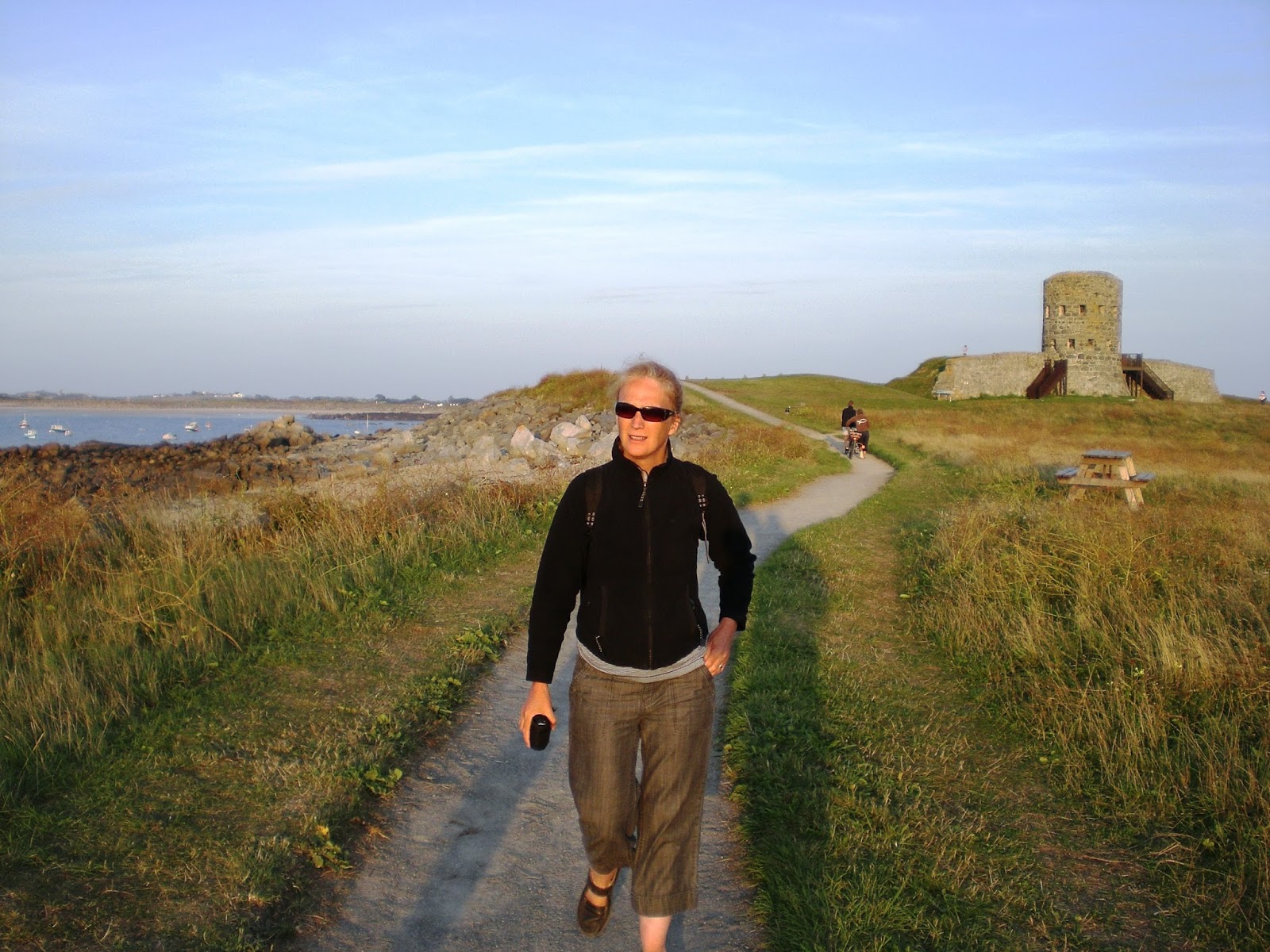
| Ann, two years ago. |
The news that my dearest friend, Ann, had passed on was a shock which numbed me until the hour of her funeral. For I could
not – cannot - imagine a world without her. She had been part of my life, whether near or far away, for nearly 37 years.
There were
many years, of course, when we had little contact because I was in Kenya. We had
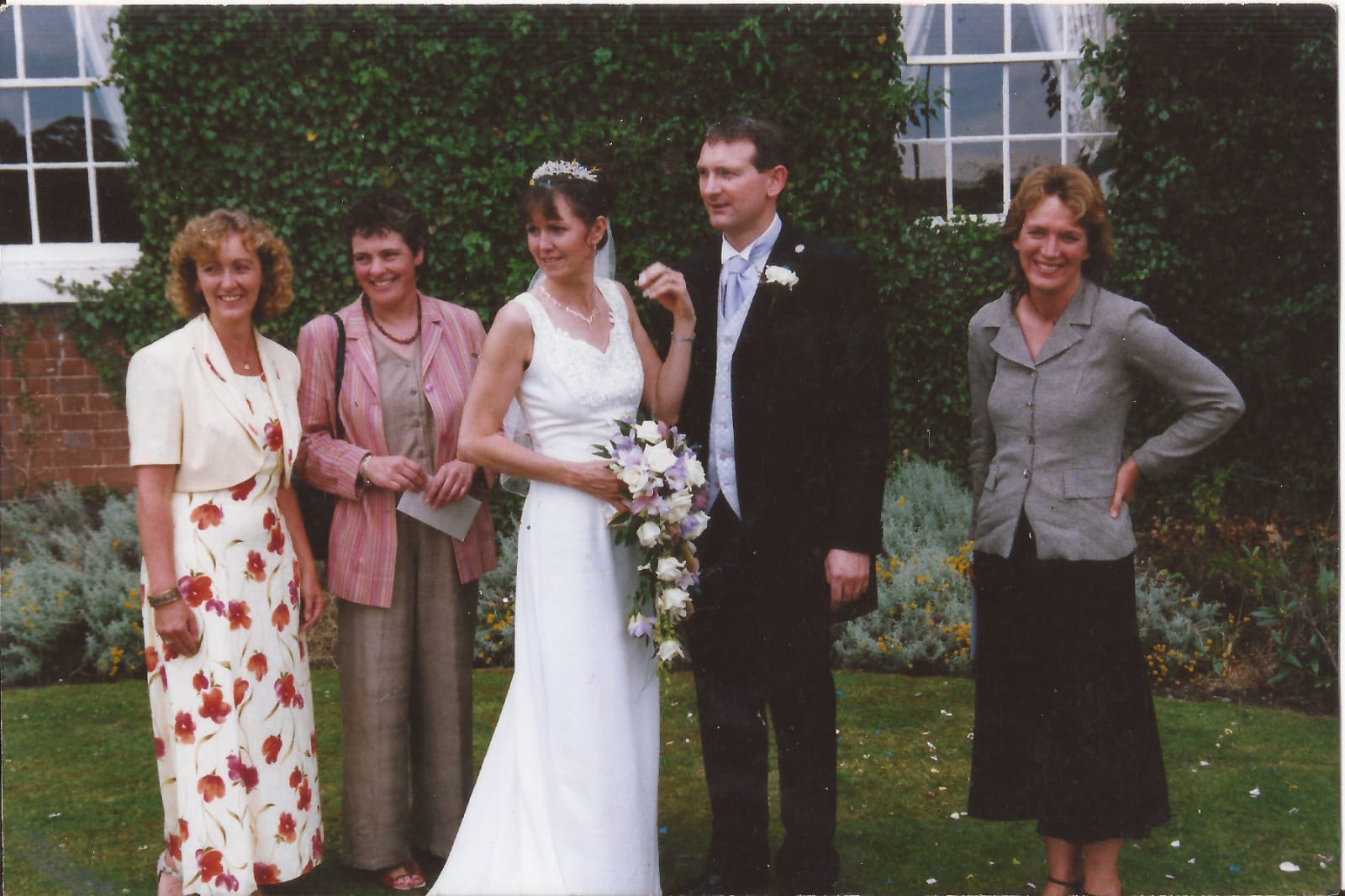
long-standing jokes: that she didn’t invite me to her wedding : I found out
when I rang her, hoping to meet up when I was visiting England, only to hear from
her mother that Ann was on her honeymoon. I hadn’t even realised that she was
engaged. I forgave when I realised how happy she was with Richard. He became a dear friend: we loved them both dearly.
Ann insisted
– until I found a photo to prove the contrary – that she had never come to my
own wedding, claiming that she hadn’t been invited. So, we joked, poring over
the wedding album: there you are, Ann; you must have gatecrashed AND got
yourself into the official wedding photos.
Such a quick
wit: the time she told me she’d had to take the day easy as she knew she had a
stressful hospital visit in the afternoon and that she would be seeing me
afterwards, which would be ‘traumatic’ – her word. I shudder to think about my riposte on
hearing that she had planned her funeral: I asked her, in jest of course, when
it would be. “I’ll let you know,” she replied. But of course she didn’t. It was
up to her husband Richard to do that.
 |
| Ann and Richard, October 2016. |
 |
| Ann, October 2016 |
I didn’t
want her to die. I DIDN’T WANT HER TO DIE.
What would the world look like without her?
Ann, who was
closer than a sister. Who knew me inside and out, told me truth about myself as
no one in the entire world could. Spoke truth into my life and my heart. She touched me in the deepest part of my soul. She could put her finger on things in me which I barely knew myself. Sometimes, indeed, the truth she spoke to me about myself hurt (Truth has its way of doing that): but I knew I was unconditionally loved. She was a rock of encouragement, love and truth. To lose her is indeed to lose a sister, a friend who was and is, as the Bible says: “Closer than a brother.” (That verse applies to sisters, too!)
We have
shared endless hours of talking, late into the night. Shared a bed, sleeping
top to tail in the simplest of ‘hotellis’ en route to visit Lake Turkana.
Shared hopes and dreams, but more often fears and failures and difficulties and
yet ending up laughing and encouraged.
We could stay up all night. We shared our most embarrassing and foolish
moments – and liked to remind each other of them, as well. We made each other
laugh. I didn’t see enough of her,
although periodic phone calls were always revitalizing. And looonng.
July 1981
was the first time I met her, in London Colney in Hertfordshire at the
headquarters of the Volunteer Missionary Movement. We’d both joined as
volunteer teachers, hoping to be used by God in Africa, responding to words
from Isaiah: “Here I am, send me.” We’d sat
next to each other during the first community prayer and worship session,
watching in bemusement as, gradually, the others rose to their feet and joined
in dancing around the chapel to the refrain of ‘Bind us together’. She turned
to me after it was finished and nearly everyone had left. “I don’t think this
is for me,” she said. “Me neither,” was my reply. We
instantly bonded, survived the preparation course, went out to Kenya where we
worked about an hour’s drive away from each other and even travelled on the
same plane. We did indeed learn to clap and sing in praise and worship - it
WAS our ‘thing’, after all. A few months later
on 2nd February 1982, we both set foot on Kenyan soil for the first
time, living and working an hour away from each other.
We visited
quite frequently, each struggling with our own challenges: adjusting to the
simplicity of life in rural Kenya was the least of them. Addressing our own
inner demons and shortcomings, coming to terms with the real inner person, was
sometimes more than we could manage but we learned to face them and support
each other. We journeyed up to Lake
Turkana together in buses and matatus
and on the back of a maize lorry. Ann’s
compassion for the poor, her knowledge of geography and her large and close-knit
family left me a little in awe of her: but she was always able to dispel any
false notions I had with a quick comment.
Even the
Africans thought we were sisters, though her hair was straighter and longer
than mine: there was still a similarity in our heights, figures and the way we
walked.
Her
unwavering faith has been an inspiration. I have been privileged to pray for
her, alone and in silence, with her and out loud. In a garden centre parking
lot and in a chapel of healing.
And kind.
Ann was so kind. She loved my parents, who were ‘very good’ to her – I took
their friendliness and hospitality for granted, but she never did, valuing them
tremendously. She would meet my plane when I came to visit my parents in
Cheshire, driving miles to Manchester Airport to pick me up. One time, she was
half an hour late: she’d got lost in the airport, driving round and round until
she finally found me. She stopped the car on a double yellow line, turned off
the engine and threw her arms around me in a tremendous hug. I noticed a police
car just a few yards away. “Um, Ann – there’s a police car just there. Do you
think we should move off – we’re illegally parked.” She dismissed my suggestion
with a wave of her hands. “Oh, it’s fine – we’re old friends. I’ve had to ask
them several times how to find where to pick you up.”
She
was wonderful at recognising beauty in other people and in circumstances. She
was quick to recognise God’s loving hand in prompting others to action. She
loved flowers, birds, nature...
I loved her
absolute dedication to our Lord Jesus. Like all of us, she had questions and
doubts but once determined, she was resolute in what she did. I admired her
patience and commitment. And she was so REAL, with such a brilliant sense of
humour.
And how we
laughed and laughed together, especially over the memory of our embarrassment
when we tried to photobomb Cath’s wedding photo. Well, we didn’t really, we
just wanted a snap of her with all of us – including Mary D (Mary Doherty, who
became Mary Carpenter and then moved to Westport in Ireland) – but it wasn’t a
suitable time and so we were asked to move!!
We never let Cath forget that...that she ‘didn’t want’ us in her wedding
photo.
The talking,
talking, talking: for hours. The
blessing of being known and loved unconditionally. The encouragement, the
reminders of God’s goodness. So much love.
Visits were treasured. Ann visited me in Guernsey several times: once, just after her mother died, on Mothering Sunday, taking a Mother's Day gift of a pot of primulas from our church service back home with her. She came, twice, with our other two 'sisters', Cath and Mary. We had such fun: we walked and explored; at breakfast in the garden; gathered on the sofa bed late at night, talking and drinking Bailey's with ice - Mary's idea; went kayaking, which produced one of the funniest memories.
Our first 'sisters' visit to Guernsey in 2009.
 |
| Ann clowning around near the bottom of the cliffs. Yet it was on the path just above this, as we climbed back up, that she became so breathless, having to stop, coughing. We urged her to get her breathlessness checked up on.... it was the beginning of the cancer, diagnosed a few months later.... |
 |
| Meeting up with Alan Jouanny and family on Herm. Alan, from Jersey, had been with us in Kenya, also in the same group with VMM, travelling out with us on the same plane.... |
 |
| Ann had more than a little trouble getting used to her bike... |
 |
| Such fun... so many happy memories... |
We had a double kayak, so Mary and I set out across the bay while Cath and Ann changed into wetsuits. I wish I'd been there. Ann had tremendous difficulty with her wetsuit. It's not easy to pull on tight neoprene in any case - almost a learned skill, but Ann managed to get hers on a total of three times.  The first time: back to front. Oops, uncomfortable. The second time: inside out. Hmmm. The third time, she nearly got it upside down but managed to work it out and get it on properly. I can't remember how she extricated herself afterwards...
But during the summer visit in 2009, she alarmed us by having to stop during a walk on the cliffs to catch her breath, pausing for a while. "It's just asthma," she panted, "at least, the doctor thinks so."
"Ann, you need to get it checked out properly," I urged, concerned: it didn't sound like asthma to me.
It wasn't. A couple of months later, and lung cancer - the same cancer which her mother had suffered from - was diagnosed.
 |
| The top of the cliffs... where we first noticed something was wrong. |
We googled it. Prognosis: no more than five years. Ann defied the odds, again and again, but there was no cure and she was not healed in her physical body here.
There were other times we all met up, including a visit to Ireland and a return visit to Guernsey.
But there was also a time when Ann could not make one of our get togethers in Lichfield: she had been away for several days on a long-distance walk and had something else a couple of days later. She was tired and couldn't fit it in. But we knew, also, that she had begun to prepare herself for her departure, with pilgrimage and prayer and an increased focus, especially after early retirement, on good works. She was involved with various social and healing ministries, being a trustee of one charity and attending healing weekends, praying with people. Her compassion always extended outwards, away from herself.
A year before she died, as Ann was, even then, dying, she was at a particular crisis point. She had developed lung cancer when she was 52 and hung on until she was nearly 61, another 8 years or so. A blockage had caused her intense breathing difficulties; there was then a ‘procedure’ to remove it; and then, as she was unable to breathe without a machine, she was put into an induced ‘sleep’. A coma. Then the doctors told us to ‘prepare for the worst’.
For her, of course, it was not the worst. She had longed to be united with her Lord and Saviour, whose Spirit she adored and had pursued with prayer and good works for many years. Indeed, these last few years especially seemed to have been a time of preparation. She was involved in pilgrimages and healing ministries, supporting the work of others with her prayer and involvement.
But for me, it was – and is - the worst. I did not want to lose her.
I prayed for a miracle. I prayed that the Spirit touched her poor body so powerfully that all traces of cancer and disease would be removed. I prayed for COMPLETE and MIRACULOUS HEALING.
I was not
ready to let her go. She was far too precious. Angry at the thought of losing
her – for I could not imagine her not being in my life here on earth – I cried
out to God. This could not be her time.
And it wasn’t.
As I prayed, I envisaged her lying peacefully in her white hospital room: white
sheets, white walls, windows set high up above eye level. And on the window
ledges were perched white angels: the beautiful feathery pre-Raphelite type of
angel, watching over her.
It seemed
like an eternity: a week, ten days...? News from Ann’s husband Richard was that
she was ‘sleeping’ peacefully. It sounded as if she was drifting away, but
still we prayed... until, one Sunday morning, I ‘saw’ the angels again, this
time in beautiful rainbow hues, gently multi-coloured and bright. Then the news
came: Ann had woken up, was sitting up, even, with tea and toast. By Tuesday
she was home.
A reprieve.
But it was
not to be. She struggled bravely on, enduring procedure after procedure. A year
after her ‘return’, she went back to hospital for another procedure. Already
very weak and weary, she developed pneumonia, slipping gently away a few days
later.
And again,
unknowing, I had a sense that she had passed through the door. We had been in
France, travelling around, visiting many old churches. Several of them were on
the Compostelle route, the pilgrimage to Santiago, the Way of St James. I
thought often of Ann: we talked about pilgrimage, a dream she had of walking
the Way. She never managed it, though she did other walks and spent her life as
an eager pilgrim, constantly seeking out God and extending his compassion to
others.
The day she
died, we visited a village which was a centre for pilgrims: two routes
converged before continuing south towards Spain. As I walked into a huge
ancient church, so dark inside that it was difficult to distinguish the
paintings over the altar, I noticed a large display of votive candles. Many were
lit and glowing alive, testimony to the prayers people had said as they lit the
candle for a loved one or a particular cause.
The thought
entered my mind to light a candle for her. I had seen these votive candles many
times, but never felt prompted to light one until then. I told myself I might do
it on my way out, choosing to wander round the church first. As I neared the
display again, still half-wondering about lighting one, I remembered that it is
a Catholic tradition to pray for the dead as well as those alive who might need
some form of healing. I felt a check. It felt ‘wrong’ to light a candle for Ann
when she was alive. Lighting a candle did not validate my prayers for her
healing: I knew God loved her even more than I did and had her safely in his
arms, regardless of what I did or didn’t do.
I remembered
Jesus’s words to the women who had gone to the tomb on the morning of his
resurrection: “Why do you look for the living among the dead?” Lighting a
candle seemed, in that moment, to be lighting a candle for the dead. And I
wanted, so urgently, for Ann to live.
I left the
church, candle unlit. Returning to the motorhome, I picked up a message: Ann
had passed on that same morning: perhaps half an hour before I was in the
church. She WAS dead. But NO! Ann has
the gift of eternal life! She is ALIVE and safe in heaven with the Lord she
loved so dearly.
 |
| Candles in Pons, just before. |
Lighting
candles had absolutely nothing to do with it. God could have healed her
miraculously, yet he chose to take her home to be with him. We had had the gift
of years with her: something, indeed, to be tremendously thankful for.
And yet. The
news numbed me: I barely spoke for days.
Since hearing the news about Ann, I felt as
if I had died. Completely empty. I couldn’t speak, couldn’t cry, couldn’t feel
anything. Numb.
I regret I didn’t see more of her,
especially these latter years. I regret I didn’t write more, phone more,
especially in the last couple of years of her illness. But how do you face a
friend’s losing battle with mortality? How do you face, together, a future
where one will be in heaven and the other still struggling here on earth. I
don’t know.
Life went on in all its aspects. Ann’s
passing seemed unreal, as if I could message or phone her on my return
home, just as before. It became reality
when I heard when the funeral was, making arrangements to take the day off work
to attend. When I had to tell people, just a little, about Ann and what she
meant to me. The days crawled.
It hung
heavy on me, the funeral. The day before went about its business with mundane
joys, functioning as normal. So did I. Yet, in the pit of my stomach, lurking
over my shoulder, hanging heavy on my heart was the knowledge of loss.
I suppose I
knew it was coming. Few survive lung cancer for more than five years: Ann
outlasted all the doctors’ predictions, living for over eight. Yet nothing prepared
me for this huge sense of loss. As soon as I saw her photo in the church, I started weeping, continuing without break for the entire service. In the following hours and days, I found myself frequently breaking into tears.
Metaphors
and analogies help.
I am a
seedling, pulled away from my siblings whose roots are intricately entangled
with mine. Part of me has been ripped off, left behind as I am forced into a
new and different life without her.
I am
shattered into pieces: they will come together again, form ‘me’ again, but I
will not be the same. The jigsaw will be imperfect, misshapen like a strange
Picasso imitation. I will not be ‘right’ without her.
There is a
hole in me, a gouged-out bite savaging my flesh, leaving a gaping, tattered
wound. It will heal, but torn tissue remains, weeping silently. My life’s blood
has seeped out in tears, in the legacy of malignant cells, in hospital
imaginings from afar.
I carry a
heavy stone of grief and loss and sorrow.
And yet....
Jesus is calling. Calling to the transplant, the lonely orphan forced into a
different life, a without-Ann life, calling me to come home to him.
Jesus is
holding me, piecing me together, gently carrying me in all my brokenness.
Jesus is
filling up the wounds, flesh on and in flesh, pouring himself into me.
Jesus
carries my grief with me, bearing so much of it that it begins to lighten and
lessen....
Jesus is
here.
And just
today, I read this similar reflection on Jesus in the middle of the mess, the
broken, the unperfect life we live....We all deal with the same things...
Ann - the last time I saw her, six months before she died. Her spirit as indomitable as ever, her sense of humour always to the fore, weary as she was.






 What do you say, when someone tells you this? What do they WANT you to say?